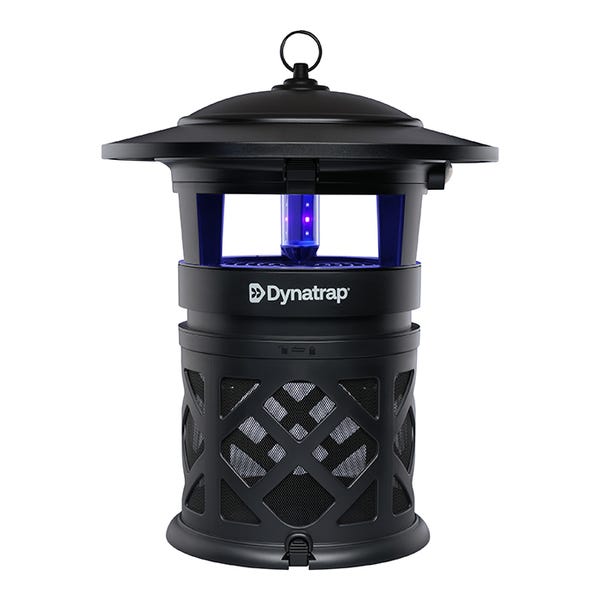
DynaTrap's DT2000XLPSR is a full-acre attractant trap sized for a typical single-family yard. UV light works alongside a titanium-dioxide CO2 surface and a whisper-quiet fan, running continuously through the season to chip away at the local mosquito population. Repellent Guide, the one cited outlet that tested this exact model, reported "I observed a discernible reduction in the mosquito population" over its first weeks, while warning that "it may take several weeks to reduce the local population". At $99 on dynatrap.com it sits below the propane class without giving up much coverage for typical suburban yards.
Full review
Reduces insect populations over a full season
The DT2000XLPSR is the trap most US backyard reviewers picked first when ranking the category, and it earns that on a season-long basis rather than overnight. Bob Vila's tester Glenda Taylor scored it 8.75/10 and said she 'emptied the basin every morning because it was always full of captured insects mostly moths but also several mosquitoes and other bugs.' MosquitoReviews graded it 9/10, though an owner quoted there reported 'I haven't noticed it's reduced the mosquito population as far as getting bit, but there are always some dead mosquitoes in the trap when I clean it out.' That said, Reviewed.com's Rebecca Viser was less impressed she found that 'it never took more than five minutes for me to start seeing multiple mosquitos' after sitting in her yard with the trap running, and concluded it caught 'nowhere near' the catch counts other reviewers reported.
The honest read across roughly a dozen long-form reviews is that the DT2000XLPSR reduces, but does not eliminate, the breeding population on a typical lot. DynaTrap itself tells buyers to expect 6 weeks before the lifecycle disruption is visible, and pretty much every published reviewer confirms that timeline. If you want bite relief tonight, this is the wrong tool; if you can run it from April through October, multiple testers reported visibly emptier yards by midsummer.
Easy assembly but placement requires strategic distance
Assembly is essentially nothing twist the bug-catch basin onto the base and plug it in. Bob Vila's tester called it 'easy assembly; a simple twist-on motion attaches the bug-catch basin.' The unit is 22 inches tall and ships with a built-in hanger so you can place it on a flat surface, hang it from a shepherd's hook, or attach it to a pole. The 6-foot AC cord is the most cited limitation because it forces placement near an outlet or an outdoor-rated extension cord. Several Home Depot reviewers ran 25-50 foot outdoor extension cords to position the trap correctly, and that is the recommended pattern.
Placement matters more than most owners realize. DynaTrap recommends locating the trap at least 20-40 feet from the patio you actually want protected so the lure draws mosquitoes away from you, not toward you. The MosquitoReviews tester noted the manufacturer's claimed 30-foot attraction radius only holds in ideal low-wind conditions, so position it upwind of dense vegetation and standing water where mosquitoes breed.
Noise and Aesthetics
The DT2000XLPSR's 'whisper-quiet' branding largely holds up. Reviewed.com's tester found the trap was only audible 'when I was only a couple of feet away' and inaudible from her hammock 10 feet off. There is no zap sound the trap kills by dehydration in the catch basin, not by electrocution, so neighbors will not be jolted by the snaps you get with a Flowtron.
Visually, the trap is the most party-friendly option in the lineup. Several reviewers compared it favorably to a standard outdoor garden lamp, and it comes in black or green metal finishes meant to recede into landscaping. That is the most common reason it edges out the cheaper Flowtron in 'best of' roundups despite having a smaller per-night kill count.
Safe for families but risky for pollinators
There are no chemicals, no propane, and no electric grid the DT2000XLPSR is safe to run around children and pets in a way the Flowtron is not. There are no shock hazards and no toxic refills to spill or change out. However, the unit's effect on beneficial insects is the unresolved category-wide concern. Bob Vila, running a DynaTrap of this design for a season, put it first-hand: "Unfortunately, it did trap some honey bees, and these valuable pollinators died inside." The trap "is not selective and can inadvertently trap and harm non-target insects", and Bob Vila’s advice is to keep it "well away from plants and water sources that honey bees are known to frequent".
Glenda Taylor's Bob Vila basin sampling 'mostly moths' is the honest illustration. DynaTrap's CO2 surface biases the catch toward biting insects more than a pure-UV zapper does, but if you garden for pollinators or have monarchs and luna moths around, this trap will catch some of them along with the mosquitoes. That is a real trade-off worth knowing before you buy.
Low running costs but frequent basin cleaning required
Operating cost is the friendliest in the trap category. The TiO2 CO2 surface needs no refills, there are no octenol cartridges to replace, and the only consumable is the UV bulb itself, which DynaTrap rates for 3,000 hours of operation roughly 4 months of continuous use. Replacement bulbs run about $20 from dynatrap.com. Power draw is 35W, which works out to roughly $3 per month of electricity at typical US rates if you leave it running 24/7.
The maintenance hassle MosquitoReviews and Bob Vila both flagged is emptying the catch basin. Bugs can escape during removal Glenda Taylor reported having to spray the basin with insecticide before unscrewing it, an unexpected step DynaTrap does not document. The fix some reviewers recommend is turning the trap off 10 minutes before emptying so caught insects fully dehydrate. Expect to dump the basin weekly during peak mosquito season.
Bulbs burned out after two weeks for one tester
Reviewed.com's negative-leaning take is the most useful counterweight to the 5-star Amazon glow. Their tester concluded that despite a full basin she 'still got mosquito bites' and recommended Thermacell systems instead for personal protection. The DT2000XLPSR is a population-control tool, not a personal-protection tool, and reviewers who tried to use it for the latter were disappointed.
Other reported shortcomings: occasional reports of premature bulb failure ('the lights didn't last as long as they said. After two weeks, they burned out' per one MosquitoReviews summary), the cord limitation forcing extension-cord setups, and the moth-heavy catch profile. None of these are dealbreakers for the population-reduction job the trap is sold for, but they are worth knowing if you expect overnight bite-free evenings.
Best placed between standing water and the living area
Homeowners with a quarter-acre to full-acre lot who can dedicate one outdoor outlet to a season-long control program. If you can plug it in by April and forget about it until October, the DT2000XLPSR is the highest-ROI option in this lineup and the one most likely to leave you with measurably fewer mosquitoes by July. Pair it with a Thermacell E90 for actual evenings on the deck, since the DynaTrap does not protect anyone at the patio.
It is not for renters who want immediate evening protection, not for camping or moving between locations, and not the right pick if you have a quarter-acre or smaller lot the smaller DT1100 series covers that for less money. It is also not the right pick if you actively garden for pollinators and want to avoid moth and bee bycatch.
One scenario worth highlighting is the lakeside or pond-adjacent property. Reviewers from Home Depot's verified-purchase corpus and Bob Vila's roundup both noted the trap performs best when placed between the breeding source (standing water) and the living area. For waterfront properties this is the natural single-purchase fit before stepping up to the Patriot Plus class, and several reviewers reported it was enough on its own through midsummer before pressure picked up in August.
Runs on about $3 a month in electricity
At $99 direct from dynatrap.com (often $79-89 on Amazon during spring promotions), the DT2000XLPSR sits in a sweet spot the budget Flowtron BK-15D is cheaper at around $60 but kills indiscriminately, while the Mosquito Magnet Patriot Plus is 5x more expensive and demands ongoing propane bills. The DynaTrap's no-refill, electricity-only operating cost (roughly $3/month in power) makes it the lowest-friction multi-season pick in the category.
Only one cited outlet tested this exact model. Repellent Guide reviewed the DT2000XLP, gave it a "Score: 9" and concluded that "it earns its place as a primary line of defense for those seeking to enjoy their outdoor spaces in peace." Bob Vila's "Rating: 8.75/10" is for the "DynaTrap ¾-Acre Insect Trap", a larger and dearer unit, and Reviewed.com tested a trap that "claims to cover a half-acre radius". MosquitoReviews' 1-acre page publishes no score of its own, only owner comments, one of which reads "I haven't noticed it's reduced the mosquito population as far as getting bit."
Strengths
- +1-acre coverage from a 35-watt UV+CO2 lure that runs silently on a 6-foot AC cord
- +Three-mode attraction (UV light, TiO2-coated CO2 surface, vacuum fan) catches mosquitoes plus gnats, no-see-ums, and biting flies
- +Bug Vila's tester scored it 8.75/10 and emptied a full basin every morning during testing
- +Bulb rated 3,000 hours (about 4 months) before replacement is needed
- +Decorative lantern styling blends into a backyard better than the typical hanging zapper
Watch-outs
- −Takes 6 weeks to break the mosquito breeding cycle, so it is a season-long tool rather than party-night relief
- −Catches large numbers of moths and beneficial insects alongside mosquitoes
- −Bobvila's tester found bugs could escape during basin removal unless sprayed with insecticide first
How it compares
Lower upfront cost than the Mosquito Magnet Patriot Plus and no propane refills, but the Patriot Plus uses true CO2 emission and catches roughly 10x more biting insects per night in heavy-infestation yards. Quieter than the Flowtron BK-15D and far less pollinator-lethal than the Flowtron's electric grid, though slower to show visible bite reduction than a Thermacell E90 during an evening on the patio.
Rating sources
“I emptied the basin every morning because it was always full of captured insects—mostly moths but also several mosquitoes and other bugs.”
“It never took more than five minutes for me to start seeing multiple mosquitos.”
Our 4.5 score is the average of the 1 scored review above; 3 more reviewed it without printing a score and are not in the average. Ratings marked * were derived from the reviewer’s written analysis or video transcript — the publisher didn’t print an explicit numeric score, so we inferred one from their own words. Click through to verify. More about methodology.